
What Sumter County Deeds Convey
All real-estate filings in the county pass through the Sumter County Clerk of Superior and State Court. Each instrument does different work. A deed conveys whatever interest its text describes. A security deed backs a debt with land. A release wipes out or trims a recorded claim. The instrument code is worth checking closely. The same name can surface on plenty of documents that move no ownership at all.
| Deed type | Legal effect shown | Typical record question |
|---|---|---|
| Warranty deed, WD | Conveys title with stated warranties | Was this an ordinary recorded transfer? |
| Quitclaim deed, QCD | Transfers the grantor's interest without broad warranty | Was an interest corrected or cleared? |
| Estate deed, ESTD | Conveys through an estate representative | Did ownership move after a death? |
| Foreclosure deed, FCD | Records a power-of-sale transfer | Did a secured claim lead to sale? |
| Sheriff's deed, SHFD | Records a sheriff-administered transfer | Was the sale tied to legal process? |
| Tax deed, TAXD | Records a tax-sale interest | Did delinquent tax process affect title? |
Georgia's chart goes well beyond basic deeds. It lists gift deeds, trustee's deeds, right-of-way deeds, timber and mineral deeds, boundary agreements, easements, covenants, leases, powers of attorney, and court orders. Match the code to the event first. Then read the document itself.
The Sumter County Recorder
The recorder here is the Sumter County Clerk of Superior and State Court, at 500 W Lamar Street, Americus, Georgia 31709. Mail goes to PO Box 333. Call 229-928-4537; published hours are Monday through Friday, 9 a.m. to 5 p.m.
The clerk keeps deeds, security deeds, easements, plats, UCC-1 filings, trade names, judgment liens, and court files. Its page links the statewide search and eCertification both. Starting with only an address? Pull the owner and parcel ID from the county GIS or qPublic first, then carry that name and legal description into the deed records index.
Search Sumter Deed Records Online
For online work, the GSCCCA search portal is the doorway most people use. Its Real Estate Index supports a name search, a book and page search, and a property search by subdivision, unit, block, or lot where a county supplies that data. Premium tools add instrument-type, address, map, and daily modes. Standard deed-index coverage for every Georgia county opens on January 1, 1999.
| Search field | Use in Sumter County deed records | Format note |
|---|---|---|
| Grantor or grantee | Find a transfer by party | Try surname first, comma, given name |
| Book and page | Open a known citation | Copy both exactly from the source |
| Instrument type | Separate deeds, releases, liens, and easements | Use the official instrument code |
| Filed date | Narrow a closing or recording period | Recording may follow signing |
| District and land lot | Match rural legal descriptions | Compare with the full deed text |
| Subdivision, block, lot | Find platted property | Try name and spelling variants |
The GSCCCA search catalog shows the related PT-61, lien, plat, UCC, and notary systems.
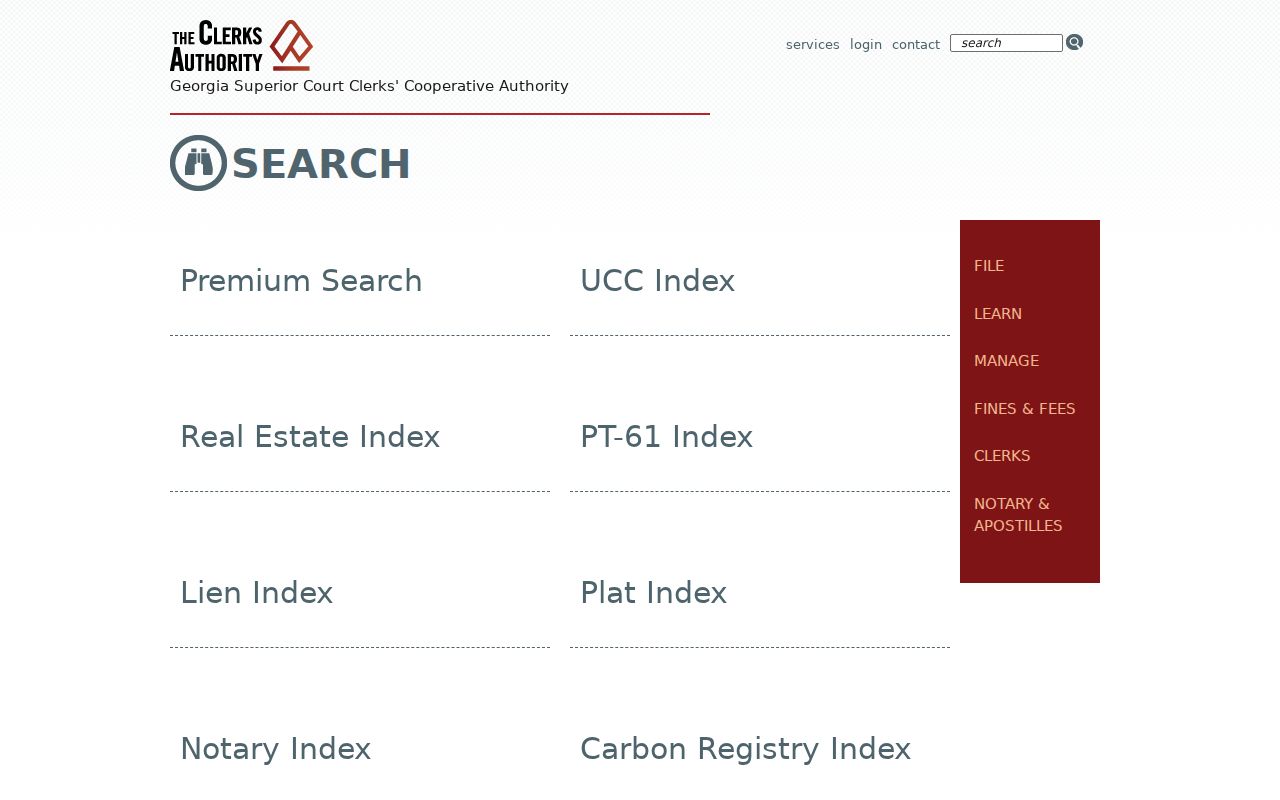
The catalog simply helps you pick the right index. Not every image, and not every historic Sumter County deed, is freely viewable there. The separate GSCCCA index entry screen is where a deed search turns from a service list into an actual query.
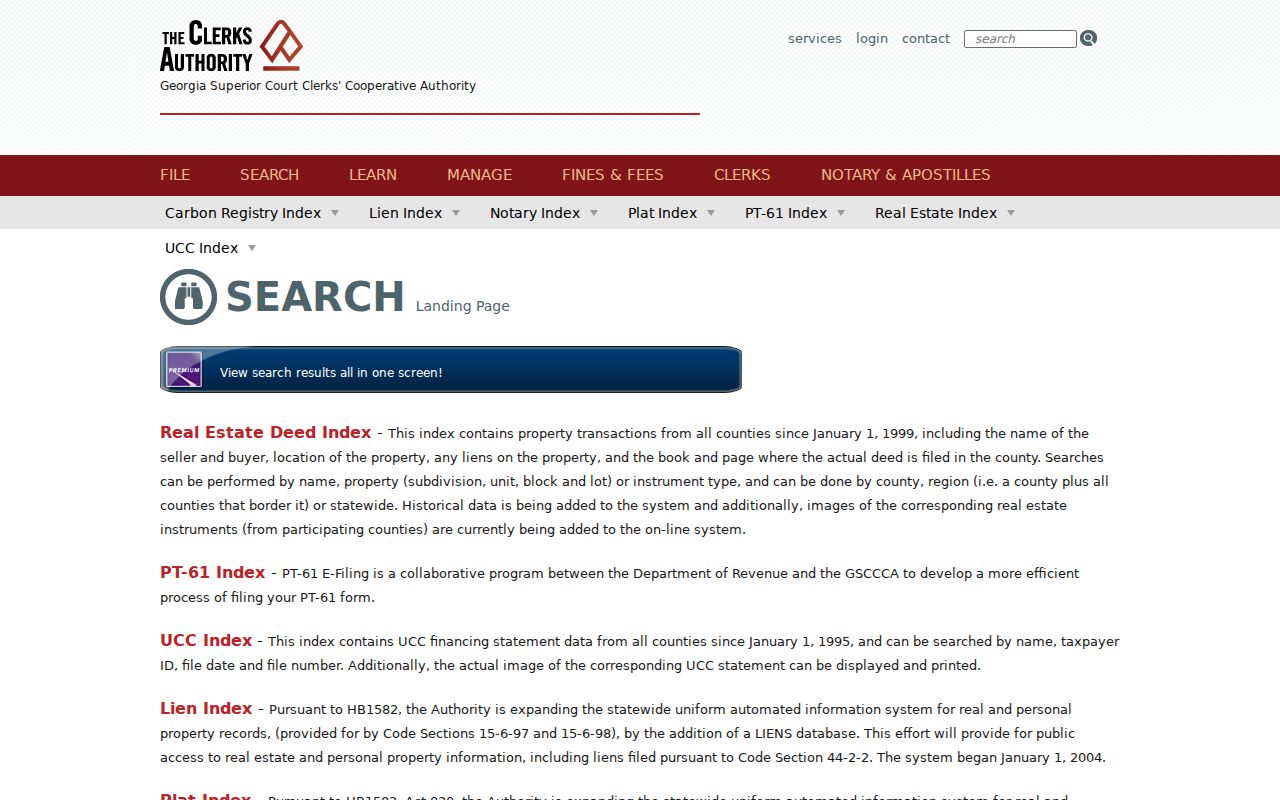
Set the county filter and enter a party or citation. From each matching row, save the filed date and the instrument reference.
Build a Sumter Grantor-Grantee Chain
A grantor gives up an interest. A grantee takes it. Put every recorded transfer in order and you have a chain of title, linking one owner of record to the next. The deed records search goes smoothly when you write each link down before stepping further back.
- Start with the newest deed matching the parcel number, legal description, subdivision, lot, or address.
- Record its filed date, instrument type, book and page or instrument ID, grantor, grantee, and property description.
- Search the grantor as a grantee to locate the deed by which that prior party acquired the tract.
- Repeat the process, checking corrections, estate names, trusts, LLC suffixes, initials, and married-name forms.
- At the online cutoff, switch to the clerk's reverse index, deed books, microfilm, or archival finding aids.
- Grantor
- The person or entity transferring the stated interest.
- Grantee
- The person or entity receiving that interest.
- Book and page
- A citation to the bound or imaged record series.
- Instrument ID
- A unique filing identifier assigned to a recorded document.
- Cross-reference
- A pointer that connects a correction, release, assignment, or related filing.
One missing link does not prove broken ownership. The transfer may sit under a different name, an estate or trust, or a corrected deed. A legal description can also shift after a parcel split.
Before the 1999 Sumter Index
The statewide online deed index starts in 1999. It does not reach back to 1831, when Sumter County was created. Historical entries keep being added, and no earlier Sumter-specific cutoff applies online. An empty web result never means no deed exists. Go to the clerk's older direct and reverse indexes instead.
The Georgia Archives research page leads to county microfilm and FamilySearch. Its finding aids name Sumter Superior Court deed books 184 through 212. They also cover Sumter Inferior Court records from 1837 through 1922. Some images are browse-only, arranged by county, book, and index. The clerk's courthouse terminal can bridge whatever a web search leaves out. A staff request works too.
Online cutoff. Standard GSCCCA deed data begins January 1, 1999; use clerk-held books and archival channels for an older Sumter County chain.
Freeman's Sumter Land Trail
A county sale notice for Freeman Subdivision shows how new and old references lock together. It names parcel 22 5 6 and Plat Book 12 page 210. It also cites Deed Book 1214 page 213, land lots 175 and 185 of the 27th Land District, a railroad, and Bill Cross Street. Each clue can be tested in its own record.
The parcel number opens the current tax and map entry. The plat citation shows the lot layout. The deed citation pinpoints a recorded transfer. Land-lot and boundary calls keep the search anchored. They hold it to the same ground even when street labels change. That is why Sumter County deed records work best beside plats and GIS, never by party name alone.
Security Deeds and Sumter Releases
A security deed, coded SD, is an encumbrance rather than a new tax-roll owner entry. Assignments can hand the secured interest to another lender. A release or cancellation ends it. Search each filing type by name, property, and time span, because an old security deed with no matching release leaves the picture incomplete.
The GSCCCA lien database opens January 1, 2004. Its codes cover fi fa, federal tax lien, levy, lis pendens, materialman's lien, preliminary notice of lien rights, orders, and releases. UCC data begins in 1995, and the plat database ran from 2004. These dates describe the standard systems, not the first paper record in Sumter County.
Sumter Deed Alerts Through FANS
Sumter County publishes no county-branded property-fraud alert of its own. Georgia fills that gap with the free Filing Activity Notification System, known as FANS. Anyone can register the names they want watched. The system sends notice when matching real-estate, lien, or plat index data is entered and transmitted.
FANS only looks forward. It does not search the full past chain. It does not stop a filing. It does not promise that every match is complete or current. Treat a notification as a prompt to pull the index entry. Open the image, and call the clerk. The statewide FY2025 report counted 85,246 registered users, 184,025 requests, and 390,697 matches through July 6, 2025. That shows the system's scale, but it says nothing about any single Sumter filing.
Request a Sumter County Deed Copy
Start with your GSCCCA account level. See whether it already delivers the deed image or print you need. If it falls short, contact the Sumter clerk. Give the staff the party names, the instrument type, the recording date, the book and page or instrument number, and the property description. Orders can go through the counter. You can also order by mail, guided by phone, or through the linked eCertified portal. First-time eCertified users must create a universal GSCCCA account first.
The clerk sets the price. Ask about the current plain-copy and certified-copy fees, the accepted payment form, and the delivery method. Confirm whether your use requires certification before you send anything. A plain image suits ordinary research into Sumter County deed records. A certified copy carries the clerk's formal certification, which courts and agencies demand when authenticity must stand on its own.
Recorded, not guaranteed. Sumter County deed records show filed instruments, but they are not a title opinion and cannot rule out unrecorded interests.